The first of the Noahide Laws is:
Prohibition of Idolatry
Do not worship idols or any entity as a deity besides the one God. This includes denying God’s unity or bowing to false gods.
Relation of Orthodoxy
Orthodox theology, as defined by the Seventh Ecumenical Council (Nicaea II, 787 CE), holds that venerating (proskynesis) icons is not idolatry because:
- The honor given to the icon passes to the prototype (the person depicted).
- Icons affirm the Incarnation: God became man in Christ and thus can be depicted (unlike the unknowable divine essence).
- Worship (latreia) is reserved for God alone; icons receive relative honor.
Jewish View(s) of Icons
Strict View (Prohibited Even for Gentiles)
- Maimonides (Rambam, Mishneh Torah, Laws of Kings 9:2–4) and others (e.g., Chazon Ish, some contemporary strict voices) classify Trinitarian Christianity itself as full idolatry for gentiles because worshipping Jesus as divine or associating partners with God (shituf) violates pure monotheism.
- Bowing to, kissing, or praying in front of human-like images of divine figures (especially Christ depicted as God-man) is seen as classic avodah zarah, akin to pagan practices the Torah condemns.
- Many medieval and later authorities treated crosses, statues, and icons as prohibited items (e.g., forbidding benefit from them, wine touched by Christians as yayin nesech).
Lenient View (Permitted for Gentiles)
- Tosafot (13th century, e.g., Sanhedrin 63b) and followers (Rabbeinu Tam, Rema, Meiri) allow gentiles a form of shituf (associating another entity with God, such as the Trinity) that would be forbidden to Jews.
- In this framework, Trinitarian worship is not considered avodah zarah for non-Jews under the Noahide code.
- Icons themselves (as opposed to three-dimensional statues) are sometimes distinguished as less severe, and the Christian claim that they are not worshipping the wood/paint but honoring the prototype is taken at face value by some authorities.
US Law
US Public Law 102-14, 102nd Congress
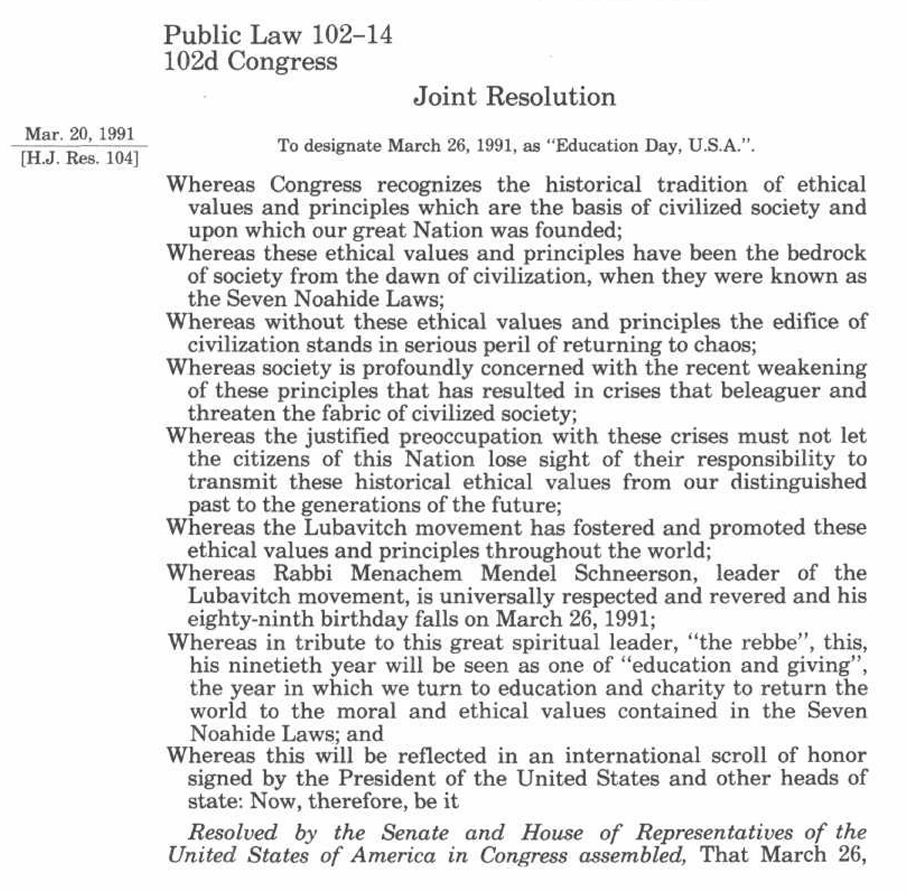
Status of the Law?
Why It Has No Enforceable Legal Effect
- It is a ceremonial/resolution law, not substantive legislation. Joint resolutions like this (especially those designating days or honoring individuals) are common in Congress (hundreds are passed every session). They express sentiment or recognition but create no new rights, duties, penalties, courts, or enforcement mechanisms.
- No operative provisions mandate anything. There is no language saying “the Noahide Laws shall be enforced,” “courts must apply them,” or anything similar. The “Whereas” clauses are precatory (expressing aspirations) and have zero binding force in U.S. law.
- It is not codified in the U.S. Code as operative law. Substantive laws appear in titles of the United States Code; ceremonial resolutions like this do not.
- No court has ever cited it as authority for enforcing Noahide Laws, and no federal or state criminal statute derives from it. Claims that it secretly makes idolatry or blasphemy capital crimes (punishable by decapitation) are fabrications with no basis in the text or subsequent legal history.
Our Response
Orthodox Christians should oppose Noahide Laws.
Leave a Reply