Jesus went to the temple in Jerusalem for Hannukah, and the Jews there tried to kill Him. Recapitulating the slaughter of the innocent martyrs in Maccabees. The miracle that happened then was Jesus escaped their hands. John 10 portrays Jesus as fulfilling or surpassing the rededication theme, claiming divine unity in the very space rededicated centuries earlier.
Jesus is the light of the world!
The Maccabean Martyrs
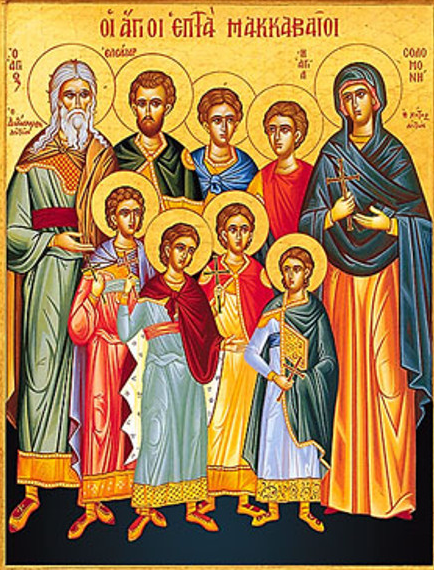
The seven Maccabee martyrs, Abim, Antonius, Gurias, Eleazar, Eusebonus, Alimus and Marcellus, their mother Solomonia and their teacher Eleazar, suffered in the year 167 BC under the impious Syrian King Antiochus. The King compelled the people to not live by the laws of God: “A man could neither keep the Sabbath, nor observe the feasts of his fathers, nor simply confess himself to be a Jew” (2 Mac 6:6).
Eleazar, a Jewish scribe, was forced to open his mouth to eat swine’s flesh, however he spat out the flesh and approached the rack on his own accord. His martyrdom is consistent with the martyrs we see after Christ: “I am enduring terrible sufferings in my body from this beating, but in my soul I gladly suffer these things because I fear Him” (2 Mac 6:30). Seven brothers with their mother were also arrested and shared the same courage as Eleazar, with the oldest stating: “What do you intend to ask and learn from us? For we are ready to die rather than transgress the law of our Fathers” (2 Mac 7:2).
One by one, all the seven brothers were subjected to fierce tortures: their tongues were torn out, their hands and feet were cut off, they were placed in cauldrons and in large frying pans. Through all these sufferings, with the help of God, they displayed an extraordinary courage addressing the King: “You set us free from this present life, but the King of the world will raise us to an everlasting renewal of life, because we die for His laws” (2 Mac 7:9).
The youngest brother was the last to be left alive and Antiochus suggested to Saint Solomonia to persuade the boy to obey him, so that her last son at least would be spared. Instead, the brave mother told him to imitate the courage of his brothers. The child reviled the King and was tortured even more than his brothers. Saint Solomonia then stood over their bodies, raised up her hands in prayer to God and died. These unwaveringly faithful Jews are examples for all of us in their courage to keep God’s law, and for this reason on their commemoration on August 1, they are called “great martyrs, before the martyrs of Christ”.
https://lychnos.org/the-seven-holy-maccabee-martyrs
Modern Jewish Celebration of Hanukkah
Hanukkah is an ancient Jewish holiday with roots going back to the 2nd century BCE, commemorating the rededication of the Second Temple in Jerusalem after the Maccabean revolt against the Seleucid Greeks. Historical sources like the Books of Maccabees (apocryphal texts) and the writings of Josephus describe its institution as an eight-day festival of lights and celebration shortly after the events in 164 BCE.It appears in early rabbinic texts: the Mishnah (late 2nd century CE) mentions it in several places regarding laws like candle lighting, and the Talmud (compiled centuries later) explains the observance, emphasizing the miracle of the oil lasting eight days while downplaying the military aspects—likely for political reasons under Roman rule.
Throughout the medieval period, Hanukkah remained a recognized but relatively minor holiday in Jewish observance, focused on home-based rituals like menorah lighting, with no major public emphasis or gift-giving traditions comparable to modern practices.
Throughout the medieval period, Hanukkah remained a recognized but relatively minor holiday in Jewish observance, focused on home-based rituals like menorah lighting, with no major public emphasis or gift-giving traditions comparable to modern practices.
There’s no substantial record of the Church developing targeted criticisms or condemnations of it, unlike with other Jewish practices (e.g., Passover or circumcision in early Christian debates). This aligns with Hanukkah’s traditionally lower profile in pre-modern Judaism—it simply wasn’t prominent enough to provoke significant theological or cultural opposition. Early Christians were aware of it (the Gospel of John mentions Jesus at the “Feast of Dedication”), but it didn’t become a flashpoint.
In the 19th-20th centuries, especially among American Jews, Hanukkah gained massive cultural prominence due to its calendar overlap with Christmas. As Christmas became a major gift-giving and family-focused holiday in the U.S., Jewish leaders and families amplified Hanukkah traditions—introducing widespread gift exchanges (starting modestly in the late 1800s and booming post-WWII), decorations, and child-centered celebrations—to provide a parallel experience and counter “December dilemma” assimilation pressures. This “Americanization” made it feel more like a “Jewish Christmas” for many, with presents helping kids not feel left out.
Leave a Reply