Posture during prayer during the time of Jesus involved various positions. It was common for full prostrations to be done in the First Century both in the Temple and in private prayers. This practice was phased out after the destruction of the Temple in 70 AD by Judaism and later forbidden in the Talmud. This practice was continued on in Orthodox Christianity down to the present time.
First Century Practices
From the Jewish Encyclopedia, Adoration, Forms of“, Louis Ginzberg. The exact relevant text states:
The three principal postures of the body at prayer prevalent among Jews in the time of Jesus—standing, kneeling, and prostration—were adopted by the Christians, at times to the minutest details.
Among the early Christians the most customary of all the Forms of Adoration was standing, adopted from the Jewish attitude during the “Eighteen Benedictions”—the prayer of prayers.
This may be seen from the numerous illustrations of that time in Aringhi’s “Roma Subterranea,” Rome, 1651-59. Their outspread hands and their faces turned eastward correspond exactly with the Jewish customs already mentioned, namely, with the ancient practise of turning toward Palestine, which for Jews in Europe is eastward, and with the practise prevalent in all synagogues, of placing the ark in the eastern wall.
The custom of kneeling, especially in private prayer, was likewise adopted by the earliest Christians (Luke 22:41, Acts 7:60; Acts 9:40; Acts 21:5; Eph 3:14, etc.) and became general (see “Hermæ Pastor,” i. 1; Clemens Romanus, i. 48; Tertullian, “Ad Scapulam,” iv.; Origen, “De Oratione,” xxxi.).
Less prevalent in the early days of Christianity was the prostration to the ground, employed only on special occasions (Socrates, “Historia Ecclesiastica,” iii. 13, 17).
How completely the Church ritual of early times was dominated by the Synagogue is shown by the usage prevalent in the Christian Church, and mentioned by Tertullian (“De Corona Militis,” iii.), that on Sunday, and during the whole week of Pentecost, prayer was not to be said kneeling. The synagogal custom (minhag), as old as the first Christian century, omits the prostration on all festivals and semi-festivals (B. M. 59b).
In the New Testament
As noted in the quote above, “the custom of kneeling, especially in private prayer, was likewise adopted [sic: continued] by the earliest Christians”
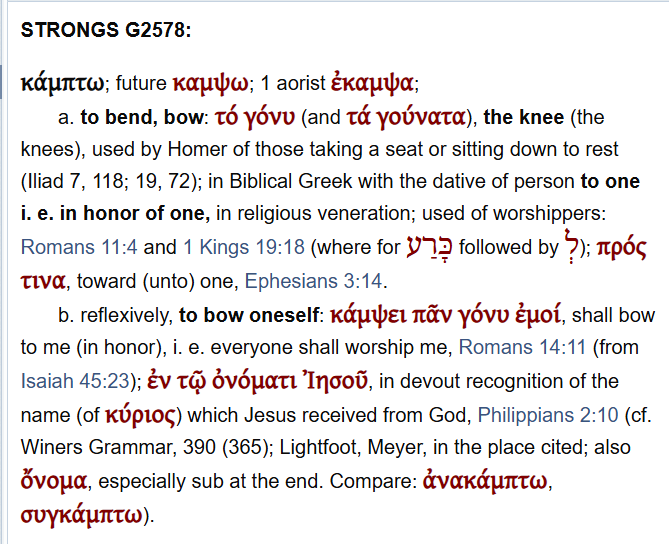
Luke 22:41 And he was withdrawn from them about a stone’s cast, and kneeled down, and prayed,
Acts 7:60 And he kneeled down, and cried with a loud voice, Lord, lay not this sin to their charge. And when he had said this, he fell asleep.
Acts 9:40 But Peter put them all forth, and kneeled down, and prayed; and turning him to the body said, Tabitha, arise. And she opened her eyes: and when she saw Peter, she sat up.
Acts 21:5 And when we had accomplished those days, we departed and went our way; and they all brought us on our way, with wives and children, till we were out of the city: and we kneeled down on the shore and prayed.
Ephesians 3:14 For this cause I bow my knees unto the Father of our Lord Jesus Christ,
Romans 11:4 But what saith the answer of God unto him? I have reserved to myself seven thousand men, who have not bowed the knee to the image of Baal.
Romans 14:11 For it is written, As I live, saith the Lord, every knee shall bow to me, and every tongue shall confess to God.
Philippians 2:10 That at the name of Jesus every knee should bow, of things in heaven, and things in earth, and things under the earth;
In the Babylonian Talmud
In Bava Metzia 59b, the context is the famous “Oven of Akhnai” dispute, where Rabbi Eliezer argues alone against the majority. After his excommunication, the text notes that prostration was a standard act in prayer, but distinguished scholars (like Rabbi Eliezer) would omit it on joyful festivals/semi-festivals to avoid implying undue humility on festive days.
This custom is presented as longstanding, reflecting practices from the late Second Temple period (first century CE), which Rabbi Eliezer embodied as a “younger contemporary of the apostles” (per the Encyclopedia).This ties directly to the omission of prostration on festivals, contrasting with its inclusion in daily prayers—evidencing its commonality in Jesus’ era, as prostration expressed penitence unsuitable for joyous occasions.
Rabbi Eliezer ben Hyrcanus (Jewish Encyclopedia) was a conservative transmitter of pre-70 CE traditions, making his era a key window into first-century Jewish prayer postures.
This reflects Second Temple Jewish customs, where full prostration (face to the ground, often with extended arms and legs) expressed deep humility and penitence in both Temple and private prayer—exemplified by Jesus himself “falling on his face” in Gethsemane (Matthew 26:39).
Rabbi Eliezer ben Hyrcanus
Rabbi Eliezer ben Hyrcanus (c. 40–120 CE), a prominent tanna and disciple of Yochanan ben Zakkai, embodied strict conservatism in halakhic practice and belief. He preserved pre-70 CE Second Temple traditions faithfully, often clashing with the evolving majority views of his Pharisaic/Rabbinic colleagues. Early Christians, emerging from similar Jewish roots, shared some practices but diverged theologically and in authority structures.
Prayer Postures
Eliezer represented first-century Jewish norms, including full prostration (face to ground) in daily prayer—omitted on festivals for joy (Bava Metzia 59b). This mirrored Jesus’ prostration (Matthew 26:39) and early Christian adoption of Jewish postures, though Christianity retained/later emphasized prostration more extensively (e.g., in Eastern traditions).
Rabbinic Judaism
Rabbi Eliezer ben Hyrcanus (c. 40–120 CE), a leading tanna known for his phenomenal memory (“a cemented cistern that loses not a drop,” Avot 2:8) and strict conservatism, preserved pre-70 CE Second Temple traditions more rigidly than many contemporaries. His teachings emphasized unwavering fidelity to received Oral Law, resisting innovative midrashic interpretation, and aligned with the conservative School of Shammai. Some aspects overlapped with early Jewish-Christian ideas (e.g., rigid Torah observance, appeal to divine signs), but these were ultimately sidelined or rejected as Rabbinic Judaism evolved toward majority rule, interpretive flexibility, and clearer separation from emerging Christianity.
In essence, Eliezer embodied a hyper-conservative strand of late Second Temple Judaism that shared traits with early Christianity (miraculous validation, strict tradition) but was marginalized as Rabbinic Judaism prioritized human reason and adaptation—facilitating separation from Christianity.
In Orthodox Christianity
These postures, especially full prostration, largely phased out in Rabbinic Judaism after 70 CE but persist vividly in Eastern Orthodox Christianity as “great metanoias” (deep prostrations touching forehead to the ground).
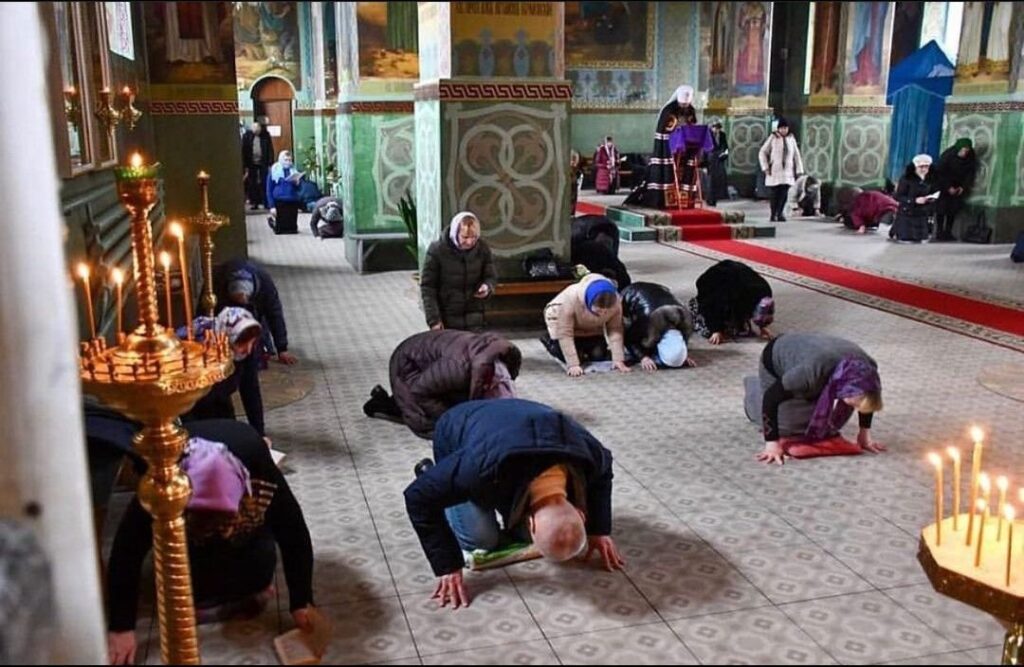
In Eastern Orthodox Christianity, great metanoias (also called great metanias, full prostrations, or proskynesis) are deep physical acts of humility, repentance, and worship. The term metanoia (μετάνοια) derives from Greek, meaning “change of mind” or “repentance,” and the bodily gesture symbolizes an inner transformation—falling down in acknowledgment of sin and rising by God’s grace.
Distinction from Small Metanias
- Small metania — A lesser bow: Make the Sign of the Cross, bow from the waist, and touch the ground with the right hand (palm open or fingers extended). This serves as a reverential bow, often used when full prostrations are not permitted or practical.
- Great metania — A full prostration: Make the Sign of the Cross, drop to the knees, place hands on the floor, and touch the forehead to the ground between them (hands flat or in fists). Then rise fully. This expresses profound penitence and is the “most complete” form of bow.
When and Why They Are Practiced
Great metanoias appear prominently during Great Lent, especially with the Prayer of St. Ephraim the Syrian (recited weekdays in Lent, accompanied by multiple prostrations—often 3 full ones plus smaller bows).
They also occur in:
- Personal prayer rules (e.g., with the Jesus Prayer).
- Monastic practice (frequently, as an ascetical discipline).
- Certain liturgical moments (e.g., entrances, veneration of the Cross).
Restrictions include:
- No great metanoias (or kneeling) on Sundays or during the Paschal season (from Pascha to Pentecost), in honor of the Resurrection (per Canon 20 of the First Ecumenical Council).
- Adapted for those with physical limitations (e.g., small metania instead).
This practice preserves ancient Jewish-Christian traditions of full prostration (as in the time of Jesus), emphasizing that worship engages the whole person—body and soul—in repentance and adoration.
Leave a Reply