Continuing the Hannukah theme
Looking deeper into Hannukah.
During Hanukkah celebrations in December 2025, Israeli Prime Minister Benjamin Netanyahu explicitly referred to the five brave brothers—the sons of Mattathias—who sparked and led the Maccabean Revolt.
In a speech at the Western Wall while lighting Hanukkah candles with IDF soldiers and U.S. Ambassador Mike Huckabee, he drew parallels between the ancient Jewish rebellion and Israel’s current conflicts, stating that the Maccabees’ success preserved Judaism and laid foundations for Western civilization. He emphasized:
“all of that would not happen if it weren’t for those five brave brothers.”
He described the ancient fighters as “heroic Maccabees” and called modern Israeli soldiers “the Maccabees of our time,” performing similar miracles “in this season as in those days.”
This directly references Mattathias’s five sons (Judah, Jonathan, Simon, Eleazar, and John/Yohanan), the core leaders who initiated the revolt against Seleucid oppression in 167 BCE, aligning with the “five men” in traditional accounts of Hanukkah’s origins. Netanyahu often invokes Maccabean themes during Hanukkah to highlight themes of Jewish rebellion
Hanukkah: When the Israelites Revolted Against the Ancient Greeks
The “seven martyrs” refer to the famous story of a Jewish woman (named Hannah or Chanah in later traditions) and her seven sons, tortured and executed one by one by Antiochus for refusing to eat pork or bow to idols. They chose martyrdom to sanctify God’s name. This story appears in ancient sources like 2 Maccabees (chapter 7) and is amplified in rabbinic texts (e.g., Talmud and midrash). It exemplifies faithful resistance during the persecution leading up to the revolt, though it’s not directly about the military victory or Temple rededication.
Rabbinic Judaism Development
Rabbinic sources expand on it:
In the Talmud (Gittin 57b) and midrashim like Lamentations Rabbah, it’s retold with added dialogues emphasizing monotheism and refusal of idolatry.
Medieval texts (e.g., Josippon) name her Hannah, linking her to biblical figures like the mother in Hannah’s prayer (1 Samuel 2:5, “the barren has borne seven”).
While not part of the military Maccabean victories celebrated in 1 Maccabees, it illustrates the spiritual defiance that fueled the broader resistance against Hellenization.
In modern Hanukkah observances, Israeli leaders like Netanyahu typically emphasize the active heroism of Mattathias and his five sons (the “five brave brothers” he highlighted in his 2025 Western Wall speech) over the martyrdom narrative, framing current conflicts in terms of fighting back rather than passive sacrifice. The two stories together represent complementary aspects of Jewish resilience during that era.
Early Christians View
Early Christians strongly emphasized the seven martyrs (the woman and her seven sons from 2 Maccabees 7, along with the elder Eleazar in chapter 6) as exemplars of faithful endurance and precursors to Christian martyrdom.
The story of their torture and death for refusing to violate God’s laws (e.g., eating pork or bowing to idols) was reinterpreted as a model for Christians facing persecution, highlighting themes of resurrection, voluntary suffering, and divine reward—ideas that aligned closely with emerging Christian theology of martyrdom.
Key evidence includes:
Church Fathers such as Cyprian of Carthage, Origen (in his Exhortation to Martyrdom), Gregory of Nazianzus, John Chrysostom, and Ambrose of Milan frequently referenced and preached on these martyrs, often Christianizing them as archetypes of noble death.
In Christian tradition, they became known as the “Holy Maccabean Martyrs,” with a feast day on August 1 in Catholic and Orthodox calendars (pre-dating many Christian saints’ feasts).
The books of Maccabees were preserved in the Septuagint (used by early Christians), and 2 Maccabees (containing the martyrdom accounts) was more influential in patristic writings than 1 Maccabees, which focuses on the military revolt.
In contrast, the five rebels (Mattathias and his five sons, including Judah Maccabee, the leaders of the armed revolt described in 1 Maccabees) received far less emphasis. Early Church Fathers rarely quoted or referenced 1 Maccabees or the military aspects of the revolt. When “Maccabees” were discussed, it typically meant the martyrs, not the warriors.
The active, armed resistance did not resonate as strongly with Christian ideals of passive endurance under persecution (e.g., turning the other cheek).The Feast of Dedication (Hanukkah), mentioned in John 10:22–23 as attended by Jesus, commemorates the Temple rededication after the revolt’s success but was not widely celebrated or emphasized in early Christianity as a distinct festival. Overall, the martyrs’ story of spiritual defiance better fit the early Church’s context of Roman persecution than the narrative of military victory.
The seven martyrs are commemorated in the Orthodox Church on August 1. This fits the Second Temple Jewish context that the Church was born in. The contrast to later rabbinic Judaism is quite strong.
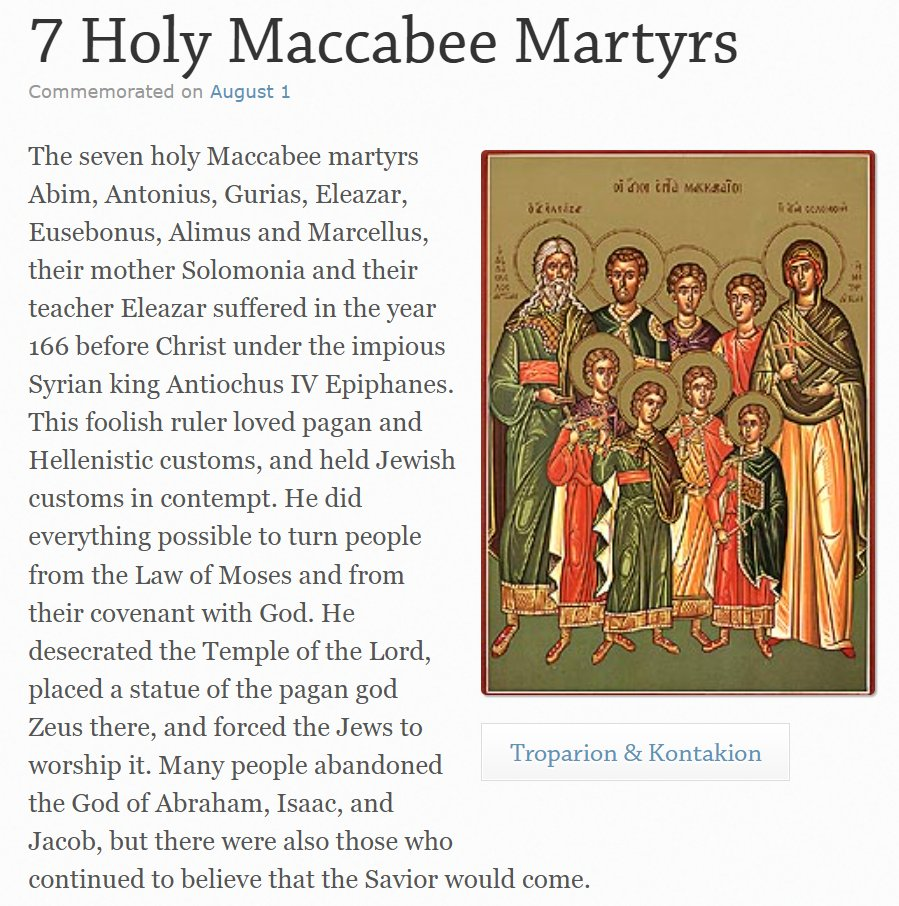
Orthodox Christian Observance
The Kontakion for the Holy Maccabean Martyrs (commemorated on August 1 in the Eastern Orthodox Church, along with their mother Solomonia/Salome and teacher Eleazar) is in Tone 2:
Seven pillars of the Wisdom of God
and seven lampstands of the divine Light,
all-wise Maccabees, greatest of the martyrs before the time of the martyrs,
with them ask the God of all to save those who honor you.
(This is the standard text used in Orthodox liturgical sources, such as those from the Orthodox Church in America and Antiochian Orthodox tradition.)
For context, the corresponding Troparion (Tone 7, often sung together with the kontakion) is:
“Let us praise the seven Maccabees,
with their mother Salome [or Solomonia] and their teacher Eleazar;
they were splendid in lawful contest
as guardians of the teachings of the Law.
Now as Christ’s holy martyrs they ceaselessly intercede for the world.”
August 1 also coincides with the Procession of the Precious Cross, so hymns for the Cross (e.g., its own troparion and kontakion) are sung alongside those for the Maccabean Martyrs in the Divine Liturgy and Matins.
The Maccabean hymns emphasize their role as pre-Christian (“before the martyrs”) exemplars of faithful endurance unto death.
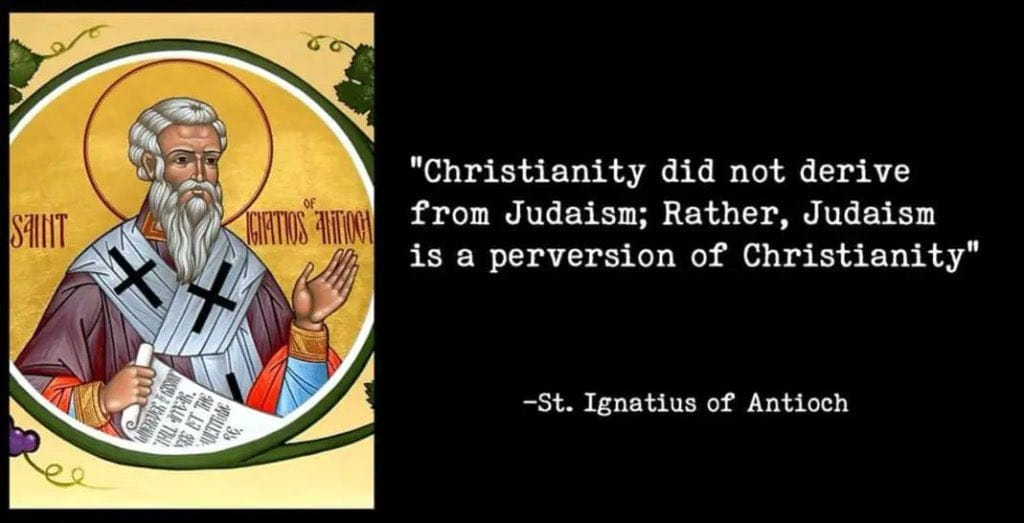
The deeper I dig into these subjects the more I understand the “paraphrased” quote. Orthodoxy really is the continuity of the Second Temple Jewish faith and “Judaism” is rabbinic and a post 70 AD development.
it’s true here that there is a Jewish scholar who takes her classes to visit Orthodox Services (particularly Vespers) to show the Jewish students what Second Temple synagogue worship was like.
We started in the synagogues and continued in the synagogues. In some places, for very long time. The Orthodox Christian faith didn’t leave the faith, the Jews did.
Leave a Reply