The Orthodox Church follows the traditions that are recorded in the Protoevangelium of James as to the account of Mary being taken to the temple at age three, Joseph being much older and being chosen to take in Mary as her protector, etc. Despite lacking biblical authority, the text of Protoevangelium is viewed as an early written record of authentic family and oral traditions circulating in the early Church.
Written around 150 A.D., this early Christian text recorded oral traditions about the life of the Virgin Mary that became foundational to Orthodox feasts and theology.
Canonical Status vs. Holy Tradition
- Non-Canonical Text. The Orthodox Church does not include the Protoevangelium of James in the New Testament canon, treating it instead as an early apocryphal writing rather than inspired Scripture.
- Preservation of Oral History. Despite lacking biblical authority, the text is viewed as an early written record of authentic family and oral traditions circulating in the early Church. The text is repository that captured existing Church traditions regarding Mary’s upbringing and relationship with Joseph.
Traditions Integrated into Orthodox Worship
- Mary’s Parents and Birth. The names of Mary’s elderly, previously barren parents, Joachim and Anna, come from this account and are commemorated in the Feast of the Nativity of the Theotokos on September 8.
- Entrance into the Temple. The account of Mary being dedicated to God and brought to live in the Jerusalem Temple at age three forms the basis for the Feast of the Entry of the Most Holy Theotokos into the Temple, celebrated on November 21.
- Joseph as Elderly Protector. Orthodox tradition holds that Joseph was an elderly widower chosen by the priests to serve as Mary’s legal guardian and protector after she reached puberty and could no longer remain in the Temple.
- The “Brothers” of Jesus. Joseph’s status as an older widower explains the New Testament references to Jesus’s “brothers” (such as James) as Joseph’s children from his previous marriage, upholding the Orthodox doctrine of Mary’s perpetual virginity.
- Birth in a Cave. The detail that Jesus was born in a cave near Bethlehem—rather than a wooden stable—is preserved in traditional Orthodox Nativity icons and liturgical hymns.
The Roman Catholic Church shares almost the exact same liturgical feasts, names, and core traditions from the Protoevangelium of James, though it differs slightly in how it explains the “brothers” of Jesus and the typical age of St. Joseph. Like the Orthodox Church, Catholicism views the text as non-canonical apocrypha that nevertheless preserved authentic early Christian oral tradition.
Shared Traditions and Feasts
- Saints Joachim and Anne. Roman Catholicism honors Mary’s previously barren parents by the exact names given in the text, celebrating their memorial together on July 26.
- Presentation of the Blessed Virgin Mary. Catholics celebrate the feast of Mary being brought to the Jerusalem Temple at age three on November 21, the exact same date as the Orthodox Church.
- Perpetual Virginity of Mary. Both traditions rely on the narrative’s framework to affirm that Mary remained a virgin before, during, and after the birth of Jesus.
- Nativity Details. Catholic art, carols, and devotional traditions frequently incorporate details from the text, such as Jesus being born in a cave and the presence of an ox and an ass
While the liturgical calendar aligns closely, Western Catholic tradition developed distinct theological explanations for Joseph and Jesus’s relatives, largely influenced by St. Jerome in the fourth century.
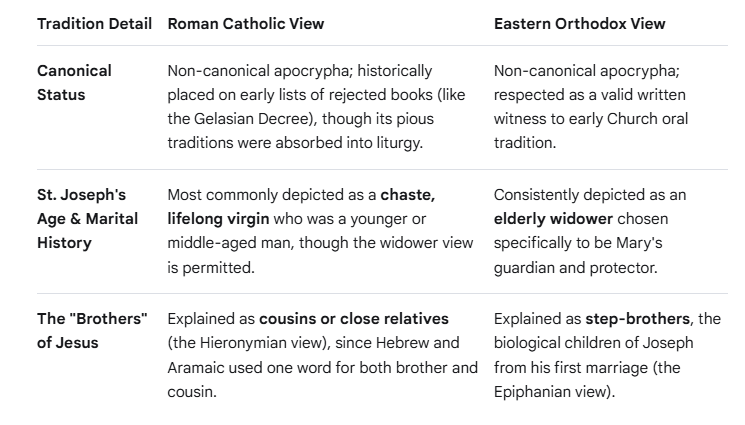
Around 383 A.D., St. Jerome argued in his treatise Against Helvidius that St. Joseph was a lifelong virgin and that the “brothers” of Jesus were actually his cousins. Jerome developed these arguments to defend the perpetual virginity of Mary while rejecting the Protoevangelium of James, which he viewed as an unreliable apocryphal text.
Writing more than a century before St. Jerome, the third-century scholar Origen of Alexandria explicitly cited the Protoevangelium of James to explain that Jesus’s “brothers” were Joseph’s children from a previous marriage. In his Commentary on Matthew (Book X, Chapter 17),
Joseph’s Former Marriage. According to this source, Origen explained that the “brethren of Jesus” were sons of Joseph by a former wife whom he had married before being betrothed to Mary.
Unlike Jerome, who later dismissed the Protoevangelium of James as unreliable fantasy and insisted on proving Mary’s virginity solely from canonical Scripture, Origen treated the text’s tradition as a valid and pious explanation.
Appealing to Patristic Authority. When the Roman writer Helvidius argued around 383 A.D. that Mary had other children with Joseph, St. Jerome was the first major Church Father to formally invoke Origen in a theological debate to refute him.
In Chapter 17 of his treatise Against Helvidius (available on New Advent), Jerome listed Origen alongside Ignatius, Polycarp, and Irenaeus as early Church authorities who upheld Mary’s perpetual virginity and opposed Helvidius’s view. Even though Jerome rejected the Protoevangelium of James itself in favor of his own cousin theory, he claimed Origen as a key witness for the underlying doctrine.
Fourth-Century Eastern Fathers. Historians and theologians like Eusebius of Caesarea and St. Epiphanius of Salamis (in his Panarion, c. 377 A.D.) promoted the exact same step-brother explanation from the Protoevangelium of James to defend Mary’s perpetual virginity against groups like the Antidicomarians. Because Origen was the preeminent biblical scholar of the Greek East, his commentary served as the foundational exegetical precedent for this view.
Modernist Readings
Academic biblical scholars generally view the Protoevangelium of James as the earliest written catalyst that popularized and shaped the belief, whereas Eastern Orthodox and Roman Catholic traditions hold that the text was merely recording an existing oral tradition from the apostolic era.
Historians note that the mid-second century saw a surge in Christian asceticism, which elevated lifelong virginity as the highest spiritual ideal. The author of the Protoevangelium likely crafted the story of Joseph’s first marriage and Mary’s miraculous, painless delivery to defend Mary’s purity against contemporary Jewish and pagan critics who claimed Jesus was illegitimate.
The Traditional View (The Text as Preservation)
Orthodox and Catholic historians argue that the Protoevangelium of James did not invent the belief out of thin air, but rather put established oral traditions into writing.
- Early Second-Century Witnesses. Apologists point to the Odes of Solomon (dated by many scholars to the late first or early second century) and the Ascension of Isaiah (early second century), both of which describe Mary giving birth painlessly without a midwife—a core motif of Mary’s miraculous virginity (virginitas in partu) that predates or parallels the Protoevangelium.
- Jewish-Christian Oral Memory. Proponents argue that the Protoevangelium reflects early Jewish-Christian traditions from Syria or Palestine that were already circulating to explain how Jesus could have “brothers” in the Gospels while remaining Mary’s only child.
- Rapid Liturgical Acceptance. Traditionalists contend that if the Protoevangelium had invented a brand-new doctrine in 150 A.D., early Church Fathers like Clement of Alexandria (c. 200 A.D.) and Origen (c. 248 A.D.) would have rejected it as a novel fabrication rather than treating its core narrative as pious, established belief.
Leave a Reply